At the end of 2024, 3,274 CMPA members were diagnostic radiologists (Type of Work 45).
The graph below compares the 10-year trends of diagnostic radiologists’ medico-legal experiences with those of all CMPA physician members.
What are the relative risks of a medico-legal case for diagnostic radiologists?
- Diagnostic radiology, College (n=808)
- Diagnostic radiology, Legal (n=634)
- All CMPA, College (n=49,331)
- All CMPA, Legal (n=13,582)
Between 2015 and 2024, compared to all physician members, diagnostic radiologists had significantly lower (p<0.0001) rates of College complaints1.
In contrast, in the same 10-year period, rates of civil legal actions were significantly higher (p<0.0001) for diagnostic radiologists than all CMPA physician members.
What are your risk levels regarding medico-legal cases, compared to other diagnostic radiologists?
Percentage of diagnostic radiologists, 5-year case frequency
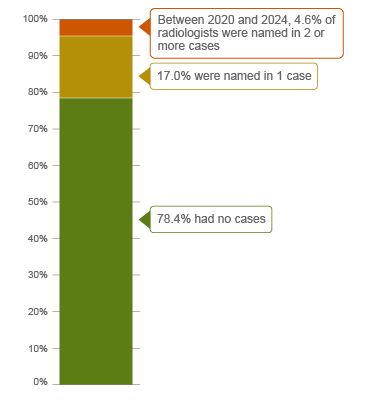
| No case |
78.4 |
| 1 case |
17.0 |
| 2 cases or more |
4.6 |
Percentage of diagnostic radiologists, 1-year case frequency
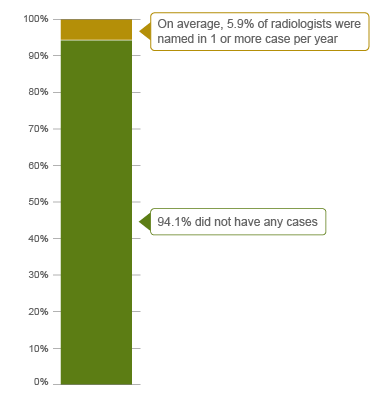
| No case |
94.1 |
| 1 case or more |
5.9 |
In a 5-year period (2020 – 2024)2, 5% of all diagnostic radiologists were named in 2 or more cases (including civil legal actions, College and hospital complaints). These diagnostic radiologists had more cases than 95% of other diagnostic radiologists.
Annually, nearly 6% had 1 or more cases on average.
The following sections describe the findings based on the 463 civil legal cases, College, and hospital complaints involving diagnostic radiologists that were closed by the CMPA between 2020 and 20243.
What are the most common patient complaints and peer expert 4 criticism? (n=463)
| Diagnostic error |
54 |
53 |
| Misinterpretation of a test |
51 |
36 |
| Deficient assessment |
16 |
7 |
| Insufficient knowledge or skill |
12 |
14 |
| Failure to perform test or intervention |
11 |
8 |
| Unprofessional manner |
9 |
2 |
| Inadequate documentation |
9 |
14 |
| Inadequate consent process |
8 |
4 |
| Injury associated with healthcare delivery |
7 |
5 |
| Inadequate monitoring or follow-up |
6 |
3 |
Complaints are driven by concerns from a patient or patient’s family that a problem or issue occurred during care. These complaints are not always supported by peer expert opinion. Peer experts may not be critical of the care provided or may have criticisms that are not part of the patient allegation. There may be more than one complaint or peer expert criticism in a case.
Diagnostic errors. A missed diagnosis, a delayed diagnosis or a misdiagnosis, are most frequent both as a patient complaint (54%) and as a peer expert criticism (53%). Of the 199 civil legal actions, peer experts had a criticism of diagnostic error in 65% (129) of the cases. Peer expert criticisms related to diagnostic cases included:
- Misinterpretation of a diagnostic test. Allegations (51%) exceed peer expert confirmation (36%) by 15 percentage points. Sometimes a finding may be subtle, ambiguous, or below the threshold of detectability, which could lead to differences between prospective interpretation and retrospective review. For example, a radiologist misinterpreted a breast nodule on a young patient as benign on ultrasound, which led to a delay in performing a mammogram and subsequent biopsy which confirmed the patient had advanced breast cancer.
- Insufficient breadth of knowledge or skill for the scope of the examination being interpreted. For example, a radiologist whose training was focused on MRIs failed to identify a mass on the kidney on a CT scan. This led to a delayed diagnosis of adrenal cancer. Peer expertise was critical of the radiologist’s ability to read the CT scan and to follow protocol for obtaining a second opinion.
- Deficient history or general assessments, including failure to consider existing patient information such as medical history, indications for procedure, or previous or current images. For example, peer experts criticized a radiologist’s ultrasound report for a patient with breast cancer, for not mentioning any comparison with previous examinations, details of changes of lesions, or relating elements in the medical file.
- Failure to perform a test/intervention, such as further investigative imaging or referral to a specialized center. For example, peer experts criticized a radiologist for not recommending enhanced imaging to investigate and identify an abnormal density on a chest x-ray. This led to a delayed diagnosis of lung cancer.
- Inadequate documentation that lacks details in an imaging report such as incidental findings, evidence of a mass, or spinal exam. For example, a radiologist failed to document an incidental finding of a thoracic mass on an abdominal CT scan that delayed the diagnosis and subsequent treatment for cancer.
What are the most frequent patient conditions associated with diagnostic radiologists’ care? (n=463)
- Cancer/neoplasms (e.g. breast, brain meninges, lung, colorectal, hepatobiliary) (142)
- Musculoskeletal disorders (e.g. arthropathies such as joint pain and soft tissue disorders, dorsopathies such as spinal stenosis) (66)
- Injuries (e.g. wrist, hand, ankle, foot) (64)
- Gastrointestinal disorders (e.g. liver cirrhosis, cholecystitis, appendicitis) (41)
- Cardiovascular disorders (e.g. cerebral aneurysm, embolisms) (33)
- Genitourinary disorders (e.g. calculus of kidney/ureter, hydronephrosis) (32)
Frequencies of presenting conditions among medico-legal cases are likely representative of diagnostic radiologists’ practice patterns and do not necessarily reflect high-risk conditions. Other frequent patient conditions in cases involving diagnostic radiologists included perinatal disorders, central nervous system disorders, respiratory disorders, and endocrine disorders.
What are the top factors associated with severe patient harm 5 in medico-legal cases? (n=463)
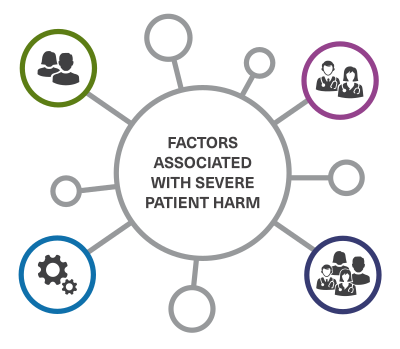
Patient factors 6
- Patient’s age > 65
- Presenting with cardiovascular conditions (e.g. cerebral aneurysm, dissection of the aorta, pulmonary embolism)
Provider factors 7
- Deficient assessment
- Failure to recommend follow-up imaging or specialist referral when an indeterminate finding was reported
- Misinterpretation of a test
System factors 7
- Inadequate facility or office administrative procedures (e.g. electronic health record was not accessible to read the preliminary report made by the radiologist)
Team factors 7
- Failure to communicate critical, urgent, or unexpected findings
- Poor coordination of care
Risk reduction reminders
The following risk management considerations for diagnostic radiologists reflect themes that emerged from peer expert review of CMPA cases.
- Conduct a thorough, systematic review of images and compare them with any available prior studies to support accurate interpretation and identify interval changes. Proactively seek out clinical context by review of the electronic health record or direct contact with the referring clinician. Ensure your radiologic impressions align with the patient’s clinical history and presentation. Consider recommending appropriate follow‑up when imaging findings and clinical information do not fully correspond.
- Incorporate clinical decision support tools and evidence‑based guidelines into your workflow to enhance diagnostic accuracy and consistency. Consider using available technology (e.g. structured reporting systems, standardized classification tools, and validated AI‑assisted applications) as adjuncts to your clinical judgment to support interpretation and reduce variability. Actively engage with peer learning and peer review programs, both as a learner and a contributor.
- Cultivate awareness of common cognitive biases, such as inattention, distraction-related blindness, satisfaction of search, and anchoring. Adopt a checklist or systematic search pattern, especially in trauma, oncology staging, and cross-sectional studies. Recognize that factors such as fatigue and after-hours interpretation may impair accuracy, and consider using overread or second-read mechanisms.
- Review your diagnostic report for completeness and clarity, including correct use of the provincial reporting and data classification system. Consider using precise, plain language to describe normal variants, incidental findings, and any recommended follow‑up actions.
- Ensure a reliable system is in place to facilitate the timely receipt, effective review and appropriate management and follow-up of investigative tests, including communicating results to patients or other physicians.
- Establish, document, and consistently follow a closed-loop system to ensure the timely communication of critical, urgent, and unexpected findings to the most responsible physician. When a finding is missed and later identified, promptly issue an addendum, along with direct communication.
Limitations
The numbers provided in this report are based on CMPA medico-legal data. CMPA medico-legal cases represent a small portion of patient safety incidents. Many factors influence a person’s decision to pursue a case or file a complaint, and these factors vary greatly by context. Thus, while medico-legal cases can be a rich source for important themes, they cannot be considered representative of patient safety incidents overall.
Now that you know your risk…
Mitigate your medico-legal risk with CMPA resources.
Concerned about your medico-legal risk? Visit the Member Support Program.
Looking for more data?
For any data request, please contact [email protected]
This report received input and review from Drs. D’Arcy Little, Tanya Chawla and Ania Kielar. We appreciate their contribution to CMPA Research work.
Notes
-
Physicians voluntarily report College matters to the CMPA. Therefore, these cases do not represent a complete picture of all such cases in Canada.
-
It takes an average of 2-3 years for a patient safety incident to progress into a medico-legal case. As a result, newly opened cases may reflect incidents that occurred in previous years.
-
The concepts and themes discussed in this report are based on de-identified clinical summaries and expert opinions in medico-legal cases involving the relevant medical specialty.
-
Peer experts refer to physicians who interpret and provide their opinion on clinical, scientific, or technical issues surrounding the care provided. They are typically of similar training and experience as the physicians whose care they are reviewing.
-
Includes severe patient harm and death. In CMPA Research glossary, severe patient harm is defined as, requiring life-saving intervention or major medical/surgical intervention, or resulting in a shortened life expectancy, or causing major permanent or temporary harm or loss of function.
-
Patient factors include any characteristics or medical conditions that apply to the patient at the time of the medical encounter, or any events that occur during the medical encounter.
-
Based on peer expert opinions.