At the end of 2025, 41,808 CMPA members were family physicians (Type of Work 35, 73, 78, 79).
How often are family physicians involved in medico-legal cases?
Specific risk levels for treating mental health conditions cannot be calculated as the number of family physicians treating specific conditions is unknown. Data for the next two sections include all civil legal actions or College complaints that the members were involved in and are not limited to patients with mental health conditions.
What are the relative risks of a medico-legal case for family physicians, compared to all physicians?
- Family physicians, College (n=23,621)
- Family physicians, Legal (n=3,014)
- All CMPA, College (n=50,851)
- All CMPA, Legal (n=13,553)
Between 2016 and 2025, family physicians had significantly higher rates of College complaints1 (p < .0001), but lower rates of civil legal cases (p < .0001), compared to all CMPA members.
What are your risk levels regarding medico-legal cases, compared to other family physicians?
Percentage of family physicians, 5-year case frequency
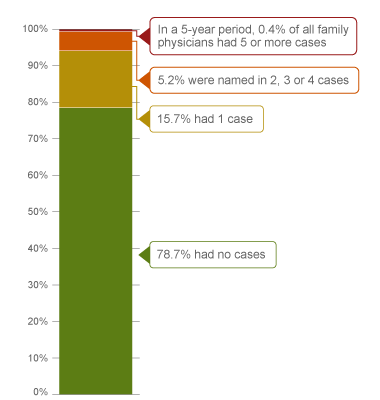
| No case |
78.7 |
| 1 case |
15.7 |
| 2-4 cases |
5.2 |
| 5 cases or more |
0.4 |
Percentage of family physicians, 1-year case frequency
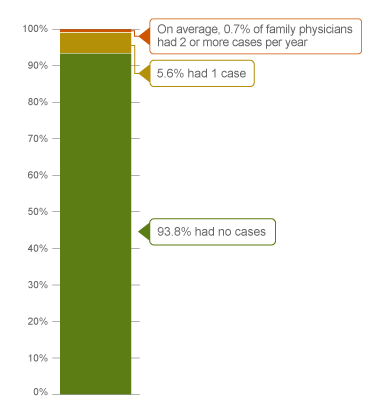
| No case |
93.8 |
| 1 case |
5.6 |
| 2 cases or more |
0.7 |
In the past 5 years (2021-2025)2, nearly 95% of all family physicians had either no medico-legal case (civil legal action or College complaint) or 1 case, and 0.4% were named in 5 or more cases.
Annually, 5.6% of family physicians were named in 1 case, and 0.7% were named in 2 or more cases.
The rest of this report shifts the focus to cases involving family physicians treating patients with mental health conditions.
For the purpose of this report, we only included cases that occurred in physicians’ offices or virtual care settings. The following sections are based on the 1,431 civil legal cases and College complaints involving family physicians treating patients with mental health conditions, closed by the CMPA between 2021 and 2025.3 These mental health conditions may be either a primary or a comorbid condition of the patient.
What are the most common patient complaints and peer expert4 criticism? (n=1,431)
| Deficient assessment |
37 |
16 |
| Unprofessional manner |
32 |
10 |
| Inadequate office procedure |
24 |
13 |
| Communication breakdown with patient/family |
23 |
11 |
| Non-optimal choice of medication |
19 |
7 |
| Inadequate documentation |
18 |
28 |
| Diagnostic error |
17 |
10 |
| Professional misconduct |
16 |
3 |
| Failure to refer |
16 |
5 |
| Poor decision-making regarding management |
14 |
5 |
Inadequate office procedure includes delayed or absent responses to patient or family communications, unprocessed or lost requests (e.g. referrals, test results, prescription refills), and inadequate systems for tracking and documenting patient care and communications.
Allegations made by a patient or their family are related to their concerns with issues during care. These complaints are not always supported by peer expert opinion. Peer experts may not be critical of the care provided or may have criticisms that are not part of the patients’ allegation.
In the 1,431 cases, a mental health condition may present as a primary concern (63%) or a comorbid condition (37%). In addition, patients often had concurrent non-mental health conditions (e.g. chronic pain disorders).
What are the top mental health presenting conditions in cases that involve family physicians who are treating patients with mental health conditions? (n=1,431)
- Anxiety disorders (332)
- Depressive disorders (202)
- Substance-related and addictive disorders (e.g. alcohol or opioid dependence syndrome) (126)
- Trauma- and stressor-related disorders (e.g. PTSD, adjustment disorders) (106)
- Neurodevelopmental disorders (e.g. ADHD, autism) (81)
The top mental health comorbidities mirrored the presenting conditions, with the exception of substance-related disorders preceding depressive disorders.
What are the top non-mental health presenting conditions in cases that involve family physicians who are treating patients with mental health conditions? (n=1,431)
- Dorsopathies (e.g. back pain, neck pain) (113)
- Neuroregulatory disorders (e.g. sleep disorders, migraine) (66)
- Soft tissue disorders (e.g. fibromyalgia, limb pain) (62)
- Arthropathies (e.g. joint pain, osteoarthritis) (60)
- Non-inflammatory gynecological conditions (e.g. gynecological pain, bleeding disorders) (25)
Frequencies of presenting conditions among medico-legal cases are likely representative of the practice patterns of family physicians treating patients with mental health conditions and do not necessarily reflect high-risk areas.
In 10% (138/1,431) of the cases, there was a diagnostic issue, including misdiagnosis, missed severity, or missed or delayed diagnosis. Peer expert criticisms in these cases were frequently related to:
- Deficient assessment, such as failing to perform comprehensive mental status and neurological exams, including a fulsome medical and family history, and a review of previous medical records. For example, a family physician diagnosed a patient with postpartum depression based solely on a high depression screening score without further evaluation or risk assessment. Later that day, a concerned family member brought the patient to the emergency department, where the patient was diagnosed and admitted for postpartum psychosis.
- Inadequate documentation, such as lacking key details on assessments, screening tools, treatment rationale, medication decisions, and communication with the patient about their diagnosis, treatment, and therapeutic expectations. For example, a patient admitted to hospital for an intentional medication overdose had been prescribed medications for anxiety and depression, yet there was no documentation in the patient’s medical record to support the diagnoses. Specifically, there was an absence of mental health assessments, suicidality risk assessments, as well as rationale and discussion of the risks and benefits of treatment and medication choices.
- Inadequate monitoring or follow-up, such as not following up on reported symptoms, failing to monitor effectiveness of treatment, and not ensuring appropriate follow-up care or referral as indicated. For example, a family physician failed to follow up on depressive symptoms and suicidal ideation disclosed on a screening tool, underestimating the severity of the patient’s condition. The physician did not discuss these symptoms with the patient, provide crisis resources, develop a safety plan, or consider referral to mental health services. The patient later died by suicide.
- Communication breakdown, such as lack of discussion regarding symptom management and treatment options, including the risks and benefits of medications, ignoring or dismissing the patient’s or family member’s concerns, and failing to explore reported mental health symptoms. For example, a physician failed to clarify and explore the reasons for a patient’s visit and did not recognize that the patient was experiencing insomnia secondary to depression when they presented for a sick note. Subsequently, the patient’s untreated depression worsened.
- Insufficient knowledge or skill of the physician in the assessment and management of mental health conditions, including not considering the impact of comorbidities (e.g. chronic pain conditions, substance use disorders) or recognizing indicators of medication interaction or toxicity. For example, a patient with mood and neurodevelopmental disorders and chronic pain died of opioid and benzodiazepine toxicity while receiving overlapping pain management treatments from their family physician and a specialist. As mental health symptoms worsened and despite signs of substance misuse, the family physician focused on escalating multiple medications for pain and symptom relief rather than reassessing the underlying mental health conditions.
What are the factors associated with severe patient harm5 in medico-legal cases? (n=1,431 cases)

Patient factors6
- Age 19-29
- Presenting with:
- Pain-related conditions (e.g. soft tissue disorders, arthropathies, nerve disorders, neck injuries)
- Complications of care:
- Intentional self-injury (e.g. overdose, suicide attempts)
- Neurocognitive disorders (e.g. mild cognitive disorder, delirium)
- Comorbidities:
- Substance-related and addictive disorders (e.g. alcohol or opioid dependence syndrome)
- Neuroregulatory disorders (e.g. sleep disorders, migraine/headache conditions)
Provider factors7
- Deficient assessment (e.g. failure to conduct comprehensive and structured mental health examinations)
- Failure to read medical records (e.g. failure to read or appreciate past medical history of mental health conditions, trialed therapies, and ‘red flags’ risk indicators for substance misuse)
- Insufficient knowledge or skill (e.g. inadequate risk assessment or inadequate use of diagnostic tools in the assessment and management of mental health conditions)
- Failure to perform tests or interventions (e.g. lack of laboratory investigations for underlying organic medical conditions that may be related to psychiatric symptoms; failing to monitor drug levels which contributed to complications from toxicity)
- Deviation from clinical practice guideline (e.g. failure to follow clinical guidelines of the Canadian Network for Mood and Anxiety Treatments; deviation from guidelines of opioid use for non-cancer pain, including unsafe co-prescribing of opioids for pain and benzodiazepines for mental health conditions)
- Failure to recognize the significance of repeat visits
Team factors7
- Communication breakdown between physicians (e.g. lack of communication between treating physicians and specialists leading to divergent/conflicting, confusing, or inadequate treatment plans and polypharmacy)
Risk reduction reminders
The following risk management considerations have been identified for family physicians treating mental health conditions. They reflect themes that emerged from peer expert review of CMPA cases.
- Ensure comprehensive and up-to-date history are taken into consideration at each visit, including current and past medications, adherence, and response to treatment. Consider relevant comorbidities and conduct appropriate mental health and neurological examinations prior to initiating or modifying therapy.
- Reassess the patient’s mental health status at every encounter, including symptoms, functional impact, and level of risk (e.g. suicidality or harm to self or others), and review relevant investigations and clinical findings to inform ongoing diagnostic and management decisions. If symptoms persist, worsen, or remain unresolved despite treatment, re-evaluate the differential diagnosis, repeat the physical examination, and consider alternative diagnoses, the need for urgent reassessment, escalation of care, or referral and consultation with a specialist.
- Maintain up-to-date knowledge about medications, including opioids, as well as treatment indications, and consider any contraindications. Assess the appropriateness of non-medication analgesia options and whether non-opioid analgesics should be prescribed.
- Document in the medical record the patient's history (include symptoms and co-morbidities), physical exam findings, mental health and neurological exams, reassessments, differential diagnoses, investigations, diagnosis, and reasoning. Include any communication, treatment plan, medication and consent related discussions, and follow-up instructions you have shared with the patient, family (with patient consent), or substitute decision maker.
- Provide the patient with appropriate follow-up and clear instructions, both verbally and in writing, including medications, symptoms/signs to monitor, and guidance on when to seek medical attention and how urgently to do so. Provide clear information on when and who to contact in case of complications. Confirm the patient’s or, where appropriate, caregiver’s or substitute decision-maker’s understanding of the information being provided, while ensuring that the patient's (and family's) questions and concerns are acknowledged and addressed.
- Protect patient privacy while recognizing that family members can be valuable partners in care, providing important context and support when authorized to participate. Patients are presumed capable of making their own decisions unless there is reason to believe otherwise. Confirm and document the patient's preferences regarding family involvement early, and share only the information the patient has consented to disclose.
- When multiple physicians are involved in the patient’s care, define individual roles and responsibilities to optimize patient care and responsiveness. Identify and communicate the details regarding ongoing monitoring to the patient and to the responsible healthcare provider, and carefully document the patient's condition, discharge instructions provided, and details of the follow-up plan.
Limitations
The numbers provided in this report are based on CMPA medico-legal data. CMPA medico-legal cases represent a small portion of patient safety incidents. Many factors influence a person’s decision to pursue a case or file a complaint, and these factors vary greatly by context. Thus, while medico-legal cases can be a rich source for important themes, they cannot be considered representative of patient safety incidents overall.
Now that you know your risk…
Mitigate your medico-legal risk with CMPA resources.
- CMPA Research:
- CMPA Learning:
Concerned about your medico-legal risk? Visit the Member Support Program.
Looking for more data?
For any data request, please contact [email protected].
Notes
-
Physicians voluntarily report College matters to the CMPA. Therefore, these cases do not represent a complete picture of all such cases in Canada.
-
It takes an average of 2-3 years for a patient safety incident to progress into a medico-legal case. As a result, newly opened cases may reflect incidents that occurred in previous years.
-
The concepts and themes discussed in this report are based on de-identified clinical summaries and expert opinions in medico-legal cases involving the relevant medical specialty.
-
Peer experts refer to physicians who interpret and provide their opinion on clinical, scientific, or technical issues surrounding the care provided. They are typically of similar training and experience as the physicians whose care they are reviewing.
-
Includes severe patient harm and death. In the CMPA Research glossary, severe patient harm is defined as symptomatic, requiring life-saving intervention or major medical/surgical intervention, or resulting in a shortened life expectancy, or causing major permanent or temporary harm or loss of function.
-
Patient factors include any characteristics or medical conditions that apply to the patient at the time of the medical encounter, or any events that occur during the medical encounter.
-
Based on peer expert opinions. These include factors at the provider, team and system levels. For cases involving family physicians treating mental health conditions, there is no evidence for system-level factors in the data.